

Turn a blind procedure into a guided one.
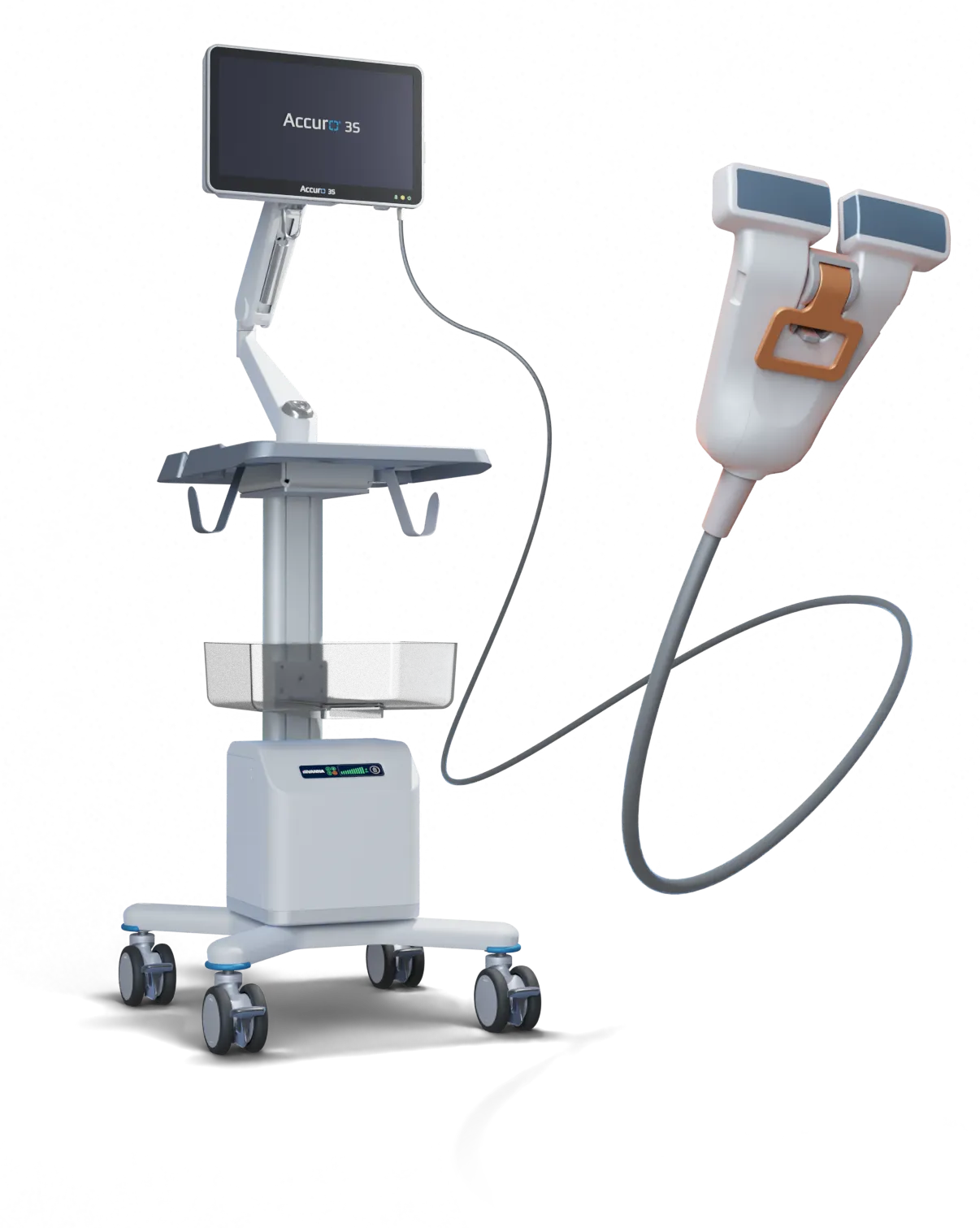
Rivanna Guidance Solutions (RGS) is establishing real-time neuraxial guidance on a simple principle: the standard a patient receives should not depend on the shift, the provider, or the body. Accuro® 3S raises that standard at the point of decision: purpose-built for the neuraxial workflow, designed to accelerate clinical decision-making, standardize image interpretation, and minimize operator variability.
FDA-cleared (510(k) K243937)
ICD-10-PCS code XEZU3HC effective October 1, 2026
1,300+ systems shipped across the RIVANNA platform
First-attempt success up from 40.0% to 72.5% (first-generation Accuro, obese-parturient RCT, p=0.003)
50+ patents and applications across 10+ families, licensed exclusively to RGS
Ninety years of loss of resistance.
Neuraxial anesthesia is among the most commonly performed procedures in medicine. Tens of millions of labor epidurals are placed worldwide every year; in the United States, 2.6 million labor and delivery neuraxial procedures are performed annually: a $300M beachhead inside a $3.5B market. For nearly a century, every epidural among them has relied on the same final confirmation: the feel of loss of resistance. The clinician palpates landmarks, advances the needle through tissue, and confirms entry by the subtle change in resistance as the tip crosses the ligamentum flavum: a skill built on anatomy, experience, and tactile precision.
That tactile confirmation is not something technology replaces. What has been missing is real-time guidance during needle advancement, in the critical distance before loss of resistance is reached.
Failure is routine in the literature, not an edge case.
The complication once described in consent forms as a slight risk that often goes away on its own is, by the evidence, a chronic morbidity. Unintended dural puncture occurs in 0.5 to 1.5% of labor epidurals, and roughly a third go unrecognized at the time of placement. Ninety years on, that incidence has not meaningfully declined. The long-term picture has shifted as the follow-up data have accumulated.
Associations with cerebral venous thrombosis, subdural hematoma, bacterial meningitis, and postpartum depression are now documented in the literature.
The patients most at risk, those with elevated BMI, prior spinal surgery, scoliosis, or impalpable midline anatomy, are also the patients for whom the blind interval between skin entry and loss-of-resistance confirmation is longest, most uncertain, and most consequential. Obesity at least doubles the odds of difficult epidural placement (2.2 times the odds of multiple attempts) and raises the odds of epidural failure 1.8-fold, with risk rising as BMI rises.
Neuraxial guidance should not stop at the skin. It should continue while the needle advances.
Accuro 3S: Real-time neuraxial guidance at the point of decision.
Accuro 3S is the first FDA-cleared, real-time neuraxial guidance system, combining AI-enabled landmark identification with continuous needle-tip tracking. The system identifies the epidural space and measures its depth, labels the anatomy, and tracks the needle tip through advancement. One single-operator workflow.
Three things have changed.
Three developments have converged across 2025 and 2026. Each would matter on its own. Together they assemble the conditions that once took decades.
1. Real-time neuraxial guidance has arrived.
Accuro 3S was cleared in 2025; SafeTrack™ needle-tip tracking, continuous and in-plane from skin entry through advancement, followed in 2026. Loss-of-resistance skill remains essential; what changes is the anatomical guidance on the way there.
2. A new ICD-10-PCS code for computer-aided neuraxial navigation.
Code XEZU3HC took effect October 1, 2026. For the first time, computer-aided neuraxial procedures are trackable in administrative data, building the infrastructure for outcomes comparison and value-case construction.
3. National quality infrastructure ready to measure outcomes.
Dural puncture rates are systematically undercounted: the United States has no mandatory national reporting, and unrecognized punctures never enter the audit record. The Multicenter Perioperative Outcomes Group (MPOG) registry spans more than 85 member hospitals, more than 28 million anesthetic cases, and 70+ active quality measures. With code XEZU3HC active, guided procedures become identifiable in MPOG data, enabling the multi-center analysis required to study outcomes in low-incidence complications at scale.
Ultrasound guidance for central lines took thirty years to become standard of care: coding accountability, guideline endorsement, and a national quality registry arrived one at a time. For neuraxial guidance, they are arriving together.
Built on the published clinical foundation.
Accuro 3S is the next generation of a clinically validated platform. In labor, a randomized trial on first-generation Accuro found epidural first-attempt success in combined spinal-epidural analgesia rose from 59.5% to 85.7%. In obese parturients, where landmark palpation is least reliable, a second randomized trial found first-attempt success rose from 40.0% to 72.5% (p=0.003). Across the platform, a meta-analysis of five randomized trials in 369 patients found guided placement 1.44 times as likely to succeed at the first insertion (95% CI 1.01 to 2.05). Accuro 3S extends this foundation; device-specific workflow and outcomes evidence begins with the Pioneer Partner Program in Q4 2026.
Shape the standard before it sets.
The Pioneer Partner Program cohort is full, and broad availability is planned for 2028. Until then, Trailblazer is how programs bring Accuro 3S in: a 2027 cohort capped at 25 programs, with applications reviewed as they arrive. Selected programs gain early market access and shape the clinical workflow before broad availability.
Sources: Niraj et al., Anaesthesia 2021;76(8):1068–1076 (prospective multicentre cohort: persistent headache 58.4% vs 17.4%, chronic low back pain 48.3% vs 17.4% at 18 months; accidental dural puncture n=89 vs uneventful epidural n=167); Eley et al., Journal of Anesthesia 2022;36(3):399–404 (single-center audit of 12,981 labor epidurals: 191 dural punctures, 60 of them, 31%, unrecognized at placement); published incidence range (dural puncture rate); Uyl et al., International Journal of Obstetric Anesthesia 2019;40:52–61 (meta-analysis, BMI ≥30 vs <30: odds of epidural failure 1.82, of multiple attempts 2.21); Guglielminotti et al., Anesthesia & Analgesia 2019 (cerebral venous thrombosis or subdural hematoma, 3.12 vs 0.16 per 1,000 with PDPH).
First-generation Accuro sources: Bae et al., Scientific Reports 2023;13:23009 (randomized trial, n=84: handheld ultrasound-assisted vs palpation-guided combined spinal-epidural for labor analgesia; epidural first-insertion success 85.7% vs 59.5%); Ni et al., Journal of Anesthesia 2021;35(4):475–482 (randomized trial, n=80: combined spinal-epidural for cesarean delivery in obese parturients; first-insertion success 72.5% vs 40.0%, p=0.003); Sharapi et al., Journal of Perioperative Practice 2025 (systematic review and meta-analysis: five randomized trials, 369 patients; first-insertion success RR 1.44, 95% CI 1.01 to 2.05). All outcome evidence: first-generation Accuro.